

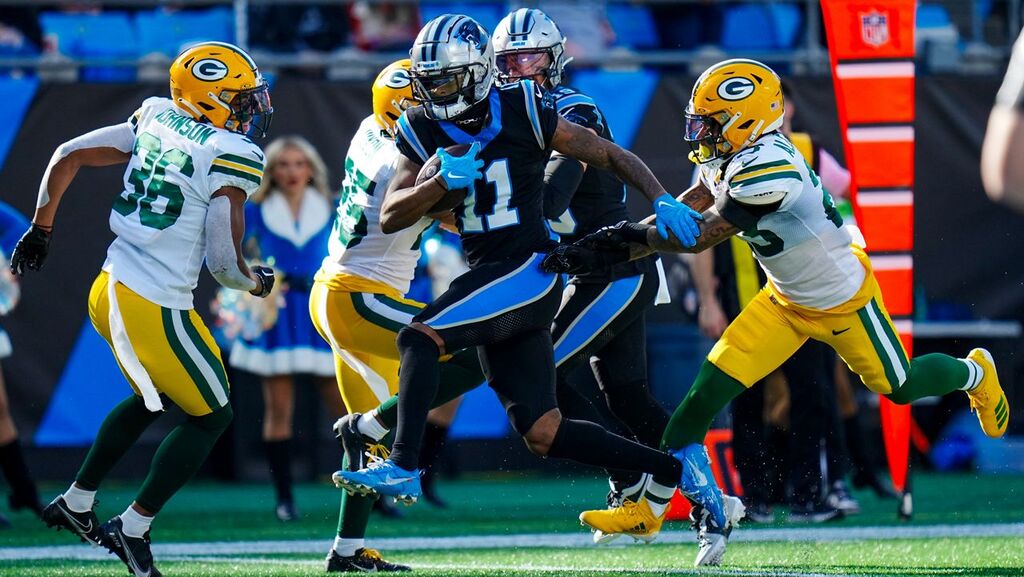
The Green Bay Packers enter Thursday Night Football as 3.5-point home favorites against the Carolina Panthers, but injuries along both offensive lines could influence how this matchup unfolds. The Panthers vs Packers Week 8 odds reflect Green Bay’s stronger record and home-field advantage, while Carolina brings the higher-scoring offense into Lambeau Field.
Green Bay is 4-3 after a 20-17 defeat against Detroit, while Carolina stands at 3-3 following a 43-13 loss to Tampa Bay. Both teams face a short recovery period, with several starters already ruled out and additional contributors carrying questionable designations.
The game begins Thursday, October 29, 2026, at 8:15 p.m. ET on Amazon Prime Video. Green Bay’s ability to pressure Bryce Young without blitzing, Carolina’s struggling run defense and the Packers’ own blocking problems create three important factors beyond the point spread.
Panthers vs. Packers Week 8 Odds and Line Movement
Green Bay is favored by 3.5 points at DraftKings, with the Packers listed at -192 on the moneyline and Carolina available at +160.
Thursday morning’s sportsbook odds comparison also shows a 47-point total at BetMGM, while several earlier published markets listed 47.5.
| Betting Market | Carolina Panthers | Green Bay Packers |
|---|---|---|
| Point Spread — DraftKings | +3.5 (-108) | -3.5 (-112) |
| Moneyline — DraftKings | +160 | -192 |
| Game Total — BetMGM | Over 47 (-108) | Under 47 (-110) |
Odds reflect the October 29, 2026, sportsbook comparison at approximately 8:26 a.m. ET. Prices and available totals may change before kickoff.
The 3.5-point spread is important because Green Bay must win by at least four points to cover. A three-point Packers victory would win the moneyline but cover Carolina’s +3.5 spread.
At -192, Green Bay’s moneyline implies a break-even probability of approximately 65.8% before bookmaker margin. Carolina’s +160 corresponds to approximately 38.5%.
Earlier betting reports referenced a Green Bay -7 look-ahead spread, with the line moving closer to a field goal as the game approached. NBC Sports also reported Packers -4.5 on Sunday night before the market reached -3.5.
That movement represents a notable reduction in Green Bay’s expected margin, although the precise influence of injuries, betting activity and other factors cannot be isolated from the available information.
The total also requires attention. With 47 and 47.5 available in different market snapshots, exactly 47 combined points would push a wager at 47 but settle Under 47.5.
Green Bay’s Pass Rush Creates a Difficult Test for Bryce Young
Carolina has one of the NFL’s most productive passing offenses, but Young has been under considerable pressure this season.
Through six games, Young has thrown for 1,712 yards, 12 touchdowns and four interceptions. His 285.3 passing yards per game place him among the league leaders.
However, Carolina’s offensive-line injuries have created a significant protection problem entering Thursday.
Starting right tackle Taylor Moton was placed on injured reserve Monday following a fractured fibula sustained against Tampa Bay. Rookie Monroe Freeling, who started the first four games while Moton was unavailable, is expected to return to the starting lineup.
Left guard Damien Lewis and reserve lineman Torricelli Simpkins III have also been ruled out.
Carolina had only seven healthy offensive linemen on its active roster when Wednesday’s injury report was released, pending potential roster transactions.
The concern becomes greater when examining Green Bay’s defensive approach.
According to Next Gen Stats figures published by the Panthers, Young has faced pressure on 44.3% of his dropbacks against four or fewer pass rushers this season.
Green Bay generates pressure on 38.5% of opponent dropbacks without blitzing, the fourth-highest rate in the NFL. Seven of the Packers’ nine interceptions have occurred without additional rushers.
That creates a challenging matchup for Carolina.
If Green Bay can consistently pressure Young with four defenders, it can retain more players in coverage and limit the passing windows available to the Panthers’ receivers.
Young was sacked five times against Tampa Bay, where pressure contributed to an offensive performance marked by turnovers and interrupted drives.
Carolina must improve its protection without relying on its usual starting offensive-line combination.
Jordan Love’s Passing Attack Faces Carolina’s Thin Secondary
Green Bay has experienced offensive inconsistency, but Love remains capable of generating substantial passing yardage.
The Packers quarterback has completed 59.8% of his passes for 1,958 yards, 13 touchdowns and five interceptions through seven games.
He has thrown at least one touchdown in every game and multiple scoring passes in six contests.
Christian Watson has emerged as Green Bay’s leading downfield target, catching 34 passes for 595 yards and six touchdowns. His 17.5 yards per reception provide the Packers with a consistent explosive-play threat.
Matthew Golden has contributed 540 receiving yards, although his availability remains uncertain because of shoulder and foot injuries.
Carolina’s secondary is dealing with its own personnel shortage.
Cornerback Akayleb Evans has been ruled out, leaving the Panthers with only two healthy cornerbacks on the active roster as of Wednesday’s official injury update.
That could force Carolina to adjust its defensive rotations, especially against Green Bay’s multiple receiving options.
The Packers lead the NFL with 33 offensive plays gaining at least 20 yards. Love has completed 30 passes of that distance, giving Green Bay an established ability to create explosive gains.
Carolina’s defensive depth will be tested if Love receives enough time to attack downfield.
However, the quarterback’s protection is also uncertain because Green Bay will be missing two important interior offensive linemen.
Packers vs. Panthers Week 8 Injury Report
The teams’ final Wednesday injury reports confirm several significant absences.
Green Bay ruled out center Sean Rhyan, offensive lineman Travis Glover and linebacker Zaire Franklin. Carolina ruled out four players, including two offensive linemen and outside linebacker Jaelan Phillips.
| Team | Player | Injury | Final designation |
|---|---|---|---|
| Panthers | Damien Lewis, G | Knee | Out |
| Panthers | Jaelan Phillips, OLB | Hamstring | Out |
| Panthers | Akayleb Evans, CB | Triceps/knee | Out |
| Panthers | Torricelli Simpkins III, OL | Ankle | Out |
| Panthers | Bobby Brown III, DT | Hand | Questionable |
| Packers | Sean Rhyan, C | Ankle | Out |
| Packers | Travis Glover, G/T | Knee | Out |
| Packers | Zaire Franklin, LB | Shin | Out |
| Packers | Matthew Golden, WR | Shoulder/foot | Questionable |
| Packers | Devonte Wyatt, DT | Ankle | Questionable |
| Packers | Anthony Campbell, DT | Ankle | Questionable |
| Packers | Brenton Cox Jr., EDGE | Quadriceps | Questionable |
Taylor Moton is separately unavailable on injured reserve. Questionable designations remain subject to final game-day decisions.
Green Bay’s official Week 8 injury report also confirms that guard Aaron Banks and cornerback Benjamin St-Juste carry no final game designation.
Rhyan injured his ankle early against Detroit, forcing John Williams into the game at center. Glover played every offensive snap at right guard against the Lions but reported knee discomfort afterward.
Their absences leave Green Bay considering several interior-line combinations involving players such as Kevin Zeitler, Jager Burton and Donovan Jennings.
On Carolina’s side, Young practiced fully and has no final injury designation despite appearing on the report with a knee issue.
Jalen Coker also carries no game designation.
The most important unresolved situations involve Golden and Green Bay’s defensive front, where the potential absence of Wyatt or other linemen could affect the team’s ability to control Carolina’s rushing attack.
The NFL’s Worst Running Game Faces Its Most Vulnerable Run Defense
One of Thursday’s most unusual statistical matchups involves Green Bay’s rushing offense and Carolina’s defense.
The Packers average an NFL-low 59.9 rushing yards per game. They have not exceeded 86 rushing yards in any contest this season.
Carolina, meanwhile, allows a league-high 153.2 rushing yards per game.
The difference between those averages is 93.3 yards, illustrating the contrast between the units. It does not, however, establish how many rushing yards Green Bay will gain Thursday.
The Panthers’ defensive difficulties were particularly evident against Tampa Bay, which rushed for 258 yards and three touchdowns during Sunday’s 43-13 victory.
Green Bay has struggled to capitalize on similar opportunities.
As examined in the Packers’ earlier Week 6 matchup against Dallas, the team’s inability to establish a reliable rushing attack has repeatedly placed additional responsibility on Love.
Josh Jacobs returned against Detroit after missing the early portion of the season and carried 11 times for 36 yards.
He contributed more effectively as a receiver, catching five passes for 55 yards and a touchdown.
Jacobs’ availability gives Green Bay another option, but Rhyan and Glover’s absences complicate the blocking assignments needed to improve rushing efficiency.
Carolina also has a potential rushing opportunity.
Chuba Hubbard has gained 459 yards on 96 carries, averaging 4.8 yards per attempt. Green Bay allows approximately 115 rushing yards per contest.
For both offenses, a productive ground game could reduce exposure to obvious passing situations and help protect injury-affected offensive lines.
Panthers vs. Packers Betting Trends Through Week 7
Green Bay enters with a 4-3 record against the spread using VegasInsider’s grading, while Carolina stands at 3-3 ATS.
Some closing-line providers grade Green Bay at 3-3-1 because its three-point defeat against Detroit produced a push at Packers +3 rather than a cover at +3.5. The distinction illustrates why a consistent pricing source matters when discussing ATS records.
The teams also have different totals profiles.
Green Bay has finished Under in five of seven games, including two of three contests at Lambeau Field.
Carolina has split its six games evenly between Overs and Unders, but all three Panthers road games have finished Under their respective totals.
Those trends are relevant to a game with a total near 47 points, particularly because both clubs face offensive-line concerns.
However, Carolina’s season-long offensive production complicates a straightforward interpretation.
The Panthers average 26.5 points and 381.3 total offensive yards per game, compared with Green Bay’s 20.6 points and 328.4 yards.
Carolina has the higher-scoring offense despite being the underdog.
Green Bay has been stronger defensively during its most recent stretch, allowing an average of 13.5 points across its last four contests.
The Packers have also produced nine interceptions and maintain a plus-five turnover differential.
That defensive improvement provides important context for their Under record, although seven completed games remain a limited sample.
Turnovers and Penalties Could Influence the Final Margin
Both teams enter following losses involving costly mistakes.
Carolina committed four turnovers against Tampa Bay, including two Young interceptions and a lost fumble. Those giveaways contributed to short fields and made it difficult for the Panthers to establish a balanced offense.
Green Bay’s defeat against Detroit was different.
The Packers converted just one of four red-zone opportunities into a touchdown and missed two field goals. Penalties also contributed to Detroit extending possessions and eventually producing the winning points.
Green Bay leads the NFL with 65 accepted penalties through seven games, including 24 before the snap.
That is an important weakness in a matchup where the spread is just 3.5 points.
A false start, holding penalty or defensive infraction can materially change field position and third-down situations without requiring an opponent to produce an exceptional play.
Carolina also struggles with discipline, averaging approximately 79 penalty yards per game, one of the league’s highest figures.
The contrast is notable: Green Bay has generated more takeaways, while both teams have repeatedly surrendered valuable yardage through penalties.
For Carolina, ball security is particularly important against a defense that leads the NFL in interceptions.
For Green Bay, avoiding self-inflicted mistakes may be necessary to convert its defensive advantages into scoring opportunities.
What the Spread and Total Suggest Before Kickoff
Green Bay’s 3.5-point favorite status reflects the advantages of playing at Lambeau Field with a defense that has improved during the past month.
However, the Packers’ offensive-line injuries, inconsistent rushing production and penalty problems create reasons for caution when interpreting the spread.
Carolina brings superior season-long scoring averages and a productive passing attack, but its own protection issues could be difficult to overcome against Green Bay’s ability to generate pressure without blitzing.
The total near 47 points also presents competing considerations.
The Packers have finished Under in five games, while Carolina’s road games have consistently produced lower scores than their posted totals.
On the other hand, both quarterbacks rank among the league leaders in passing production, and Carolina’s run defense could provide Green Bay with opportunities to improve its offensive balance.
The determining factors are likely to be protection, rushing efficiency and turnovers rather than either team’s overall record.
If Carolina can keep Young upright and avoid the giveaways that undermined its performance against Tampa Bay, its offense has demonstrated the ability to generate meaningful production.
Green Bay’s challenge is converting defensive stops into points while managing injuries along the interior offensive line.
Those matchups, together with the final inactive announcements and closing sportsbook prices, provide the most useful evidence for evaluating Thursday Night Football.


