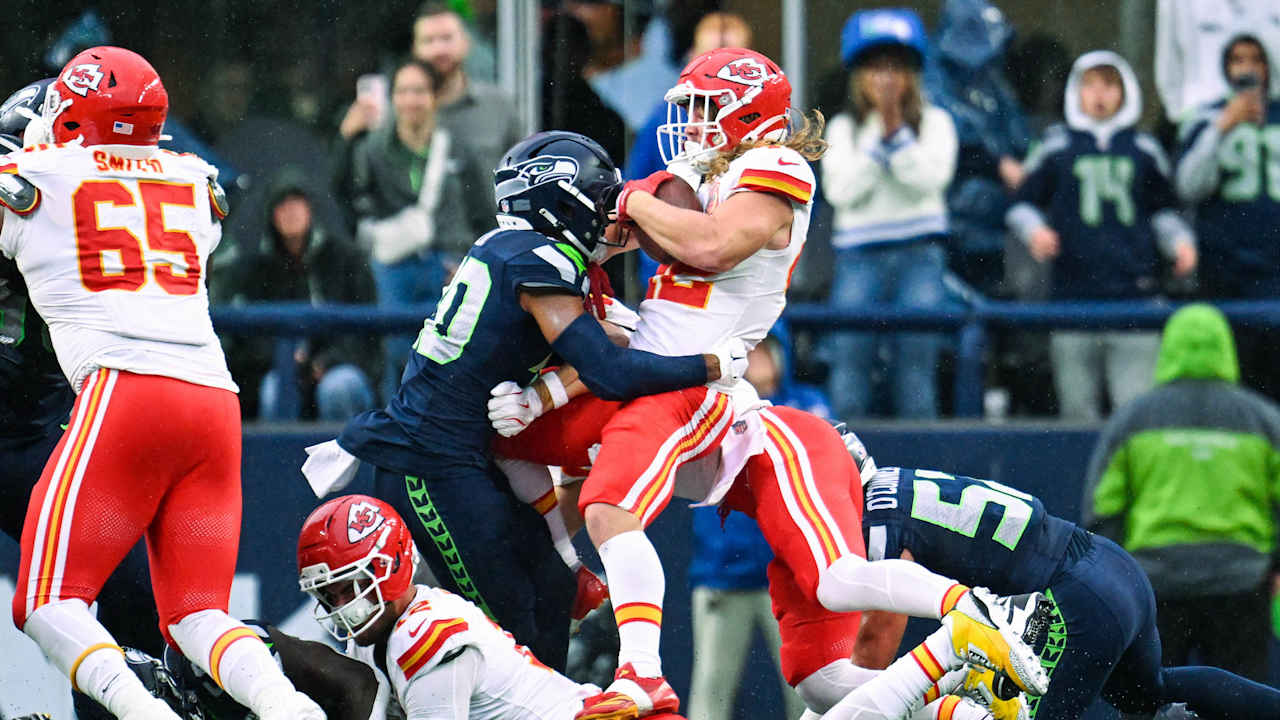
The Kansas City Chiefs enter Sunday Night Football undefeated, yet Seattle is favored by three points at home. The Chiefs vs Seahawks Week 7 odds present an unusual matchup between the NFL’s most productive offense and its top-ranked total defense, with injuries potentially influencing both teams’ approach.
Kansas City is 5-0 under Andy Reid, while the defending Super Bowl champion Seahawks have fallen to 3-3 following consecutive defeats. The teams meet Sunday, October 25, 2026, at Lumen Field, with kickoff scheduled for 8:20 p.m. ET on NBC and Peacock.
Former Seattle running back Kenneth Walker III returns as the NFL’s leading rusher, but Kansas City’s depleted offensive tackle depth and Seattle’s defensive personnel questions create additional uncertainty around the spread.
Chiefs vs. Seahawks Week 7 Odds and Line Movement
Seattle is a three-point favorite in DraftKings’ Saturday betting market, with the total listed at 42.5 points.
The following prices were available through DraftKings’ Week 7 betting board on October 24.
| Betting Market | Kansas City Chiefs | Seattle Seahawks |
|---|---|---|
| Point Spread | +3 (-115) | -3 (-105) |
| Moneyline | +124 | -148 |
| Game Total | Over 42.5 (-110) | Under 42.5 (-110) |
Odds reflect a published October 24, 2026, sportsbook snapshot and may change before kickoff.
Seattle’s -148 moneyline translates to an implied break-even probability of approximately 59.7% before bookmaker margin. Kansas City’s +124 price represents approximately 44.6%.
A three-point spread is particularly significant because a Seattle victory by exactly three points would produce a push. The Seahawks would cover that same margin at -2.5, a number available in earlier sportsbook reports.
The total has also moved. NBC Sports reported an earlier 45.5-point line before the market declined to 42.5, indicating reduced scoring expectations.
That movement makes sense to examine alongside the defensive statistics, but it should not automatically be attributed to a particular injury or betting trend without evidence connecting the two.
Kansas City’s Top-Ranked Offense Faces Seattle’s No. 1 Defense
Kansas City leads the NFL with 414.0 offensive yards per game, combining a productive passing attack with one of the league’s strongest rushing offenses.
Seattle provides an unusually difficult opponent.
The Seahawks allow just 237.3 total yards per game, the fewest in the NFL. They also lead the league in passing yards allowed at 141.3 per contest and have surrendered approximately four yards per offensive play.
Those statistics create an immediate contrast between the teams’ established strengths.
Patrick Mahomes has completed 66.5% of his passes for 1,309 yards, nine touchdowns and three interceptions. His 103.1 passer rating reflects another productive start, although Kansas City’s offensive improvement extends beyond its quarterback.
The Chiefs average 159.8 rushing yards per game, giving them a more balanced offensive foundation than teams that rely primarily on passing production.
Seattle’s defense has compensated for its inconsistent offensive performances by generating turnovers and limiting explosive plays. The Seahawks have recorded 11 takeaways, including seven interceptions.
However, the matchup is not simply a test of which unit maintains its season averages.
Kansas City’s ability to stay ahead of the chains could reduce Seattle’s opportunities to create pressure on obvious passing downs. Conversely, early defensive stops would force Mahomes into more situations where the Seahawks can disguise coverage and challenge the Chiefs’ available pass protection.
That relationship between rushing efficiency and passing situations is especially relevant given Kansas City’s offensive-line injuries.
Kenneth Walker III Returns to a Defense That Rarely Allows 100-Yard Rushers
Walker returns to Seattle with 665 rushing yards through five games, averaging 6.27 yards per carry and 133.0 yards per contest.
He leads the NFL in rushing yards, rushing average, broken tackles and runs of at least 20 yards.
His production has transformed Kansas City’s ground attack, but Sunday’s matchup presents a difficult statistical challenge.
Seattle has not allowed an individual 100-yard rusher since October 2024, a stretch of 35 consecutive games, including postseason contests.
The Seahawks have surrendered only 96.0 rushing yards per game this season, while opposing runners average approximately 3.5 yards per attempt.
Those numbers suggest that sustained rushing production could be difficult for Kansas City, although Walker’s explosive-play ability gives him opportunities to generate significant yardage without consistently gaining five or six yards on every carry.
The matchup also carries substantial history.
Walker earned Super Bowl LX MVP honors after rushing for 135 yards in Seattle’s 29-13 championship victory over New England in February. His performance was central to Seattle’s Super Bowl LX victory before he joined Kansas City during the offseason.
Seattle now faces the running back who helped deliver its second championship.
From a statistical perspective, Walker’s success matters beyond individual rushing totals. If Kansas City establishes a productive ground game against Seattle’s defense, Mahomes could benefit from shorter third downs and more favorable play-action opportunities.
If the Seahawks contain Walker without committing excessive defensive resources, they can devote more attention to Kansas City’s passing weapons.
Mahomes Faces Protection Concerns Against Seattle’s Pass Rush
Kansas City’s offensive tackle situation introduces one of the most important injury-related questions entering Sunday.
Starting right tackle Jaylon Moore has been ruled out with a concussion. Left tackle Josh Simmons, who missed the Chiefs’ first five games with a back injury, was placed on injured reserve October 22.
Those absences leave Kansas City adjusting its protection combinations against a defense that has recorded 16 sacks.
Seattle’s defensive pressure options are also uncertain, however.
Edge rushers DeMarcus Lawrence and Uchenna Nwosu are questionable because of knee and hip injuries, respectively. Both could influence how aggressively the Seahawks attack Kansas City’s offensive line.
Mahomes practiced fully Friday despite appearing on the injury report with a knee issue and carries no final game designation.
Travis Kelce was limited throughout the week with an ankle problem but also received no game designation. His availability gives Kansas City an experienced option for shorter routes and third-down situations.
Wide receiver Rashee Rice is unavailable, removing another target from the passing rotation.
With multiple offensive personnel changes, the Chiefs may need to prioritize efficient early-down execution rather than repeatedly asking their available tackles to withstand extended passing situations.
Seattle’s Passing Offense Depends Heavily on Jaxon Smith-Njigba
Seattle’s defense has performed at an elite level, but offensive inconsistency has contributed to its 3-3 record.
Sam Darnold has thrown for 1,033 yards, seven touchdowns and seven interceptions across five appearances. His 60.4% completion rate represents a substantial decline from his 67.7% mark last season.
Turnovers have been especially costly.
The Seahawks have generated 11 defensive takeaways but committed 12 turnovers, producing a negative-one differential.
Kansas City has a plus-five turnover differential, creating a six-turnover gap between the teams despite Seattle’s stronger defensive interception total.
Darnold’s receiving production has also become concentrated around one player.
Jaxon Smith-Njigba leads the NFL with 49 receptions, 717 receiving yards and seven touchdown catches. He has accounted for all seven of Darnold’s touchdown passes this season.
The rest of Seattle’s roster has combined for 752 receiving yards, only 35 more than Smith-Njigba individually.
That concentration creates an important tactical question for Kansas City’s defense.
Limiting Smith-Njigba could force Darnold to distribute the ball more frequently to secondary receivers. However, excessive defensive attention toward one target can also open opportunities elsewhere.
Pass protection presents another concern for Seattle.
The Seahawks have allowed 16 sacks, including five in each of their previous two games. Starting right guard Anthony Bradford is expected to return after missing five contests with knee and hip injuries.
His return could improve offensive-line continuity, particularly against a Kansas City defense that recorded four sacks during its 22-6 victory over the Chargers.
Chiefs vs. Seahawks Week 7 Injury Report
Both teams have important absences, although their most significant concerns affect different positions.
Kansas City’s official Week 7 injury information confirms that Moore, Rice and running back Brashard Smith will not play Sunday.
Smith suffered a hamstring injury, while Rice continues to manage hamstring and knee problems.
Cornerback L’Jarius Sneed remains questionable with a knee injury, adding uncertainty to Kansas City’s defensive backfield ahead of its matchup with Smith-Njigba.
Seattle has ruled out three players.
Running back Zach Charbonnet will miss another game while recovering from the ACL injury he suffered during last season’s playoffs. He completed full practices during the week after being activated from the physically unable to perform list, but the Seahawks determined he was not ready for game action.
Linebackers Drake Thomas and Chazz Surratt are also unavailable with ankle and calf injuries.
Safety Nick Emmanwori was added to Seattle’s injury report Friday after being limited with a hip problem and carries a questionable designation.
Lawrence and Nwosu are also questionable, along with backup quarterback Drew Lock and linebacker Connor O’Toole.
Bradford completed Friday’s practice without an injury designation. Coach Mike Macdonald expects him to play, although his return from injured reserve requires the appropriate roster transaction.
The contrasting injury situations could influence the game significantly.
Kansas City must manage its offensive tackle depth, while Seattle could enter with reduced flexibility in its defensive pressure packages.
The final inactive announcements will determine which questionable players are available Sunday night.
Chiefs vs. Seahawks Betting Trends Through Week 6
Kansas City has covered three of its first five games, according to NBC Sports’ against-the-spread records.
Seattle stands at 1-3-2 ATS through six games, including an 0-1-2 record at home.
The two pushes are particularly important because other sportsbooks have recorded different ATS results depending on their closing lines.
The teams’ Over/Under records are less decisive.
Kansas City has recorded two Overs and three Unders, while Seattle has split its six games evenly with three Overs and three Unders.
Seattle’s recent form also contrasts sharply with Kansas City’s unbeaten start.
The Seahawks lost 32-29 against San Francisco before suffering a 17-14 overtime defeat at Denver. Kansas City, meanwhile, defeated the Chargers 22-6 in Week 6 without allowing a touchdown.
Historical head-to-head results favor the Chiefs, who have won four of the last five regular-season meetings with Seattle.
Their most recent encounter took place December 24, 2022, when Kansas City won 24-10.
Those previous results provide background, but their predictive significance is limited because the teams have undergone substantial personnel and coaching changes.
The more useful indicators are the current offensive and defensive efficiency figures, turnover production and player availability.
What the 42.5-Point Total Leaves Unanswered
The posted total is relatively low compared with the teams’ season scoring averages.
Kansas City averages 28.0 points per game, while Seattle averages 24.7. Their combined scoring average is 52.7, or 10.2 points above the current total.
However, comparing offensive averages alone overlooks the quality of both defenses.
Kansas City allows just 16.6 points per game, the NFL’s second-best scoring defense. Seattle permits 20.3, placing its defense among the league’s strongest.
Those defensive averages combine to 36.9 points, substantially below the offensive total of 52.7.
The wide difference demonstrates why adding season scoring averages is not a reliable game projection. Each number reflects different opponents, game conditions and personnel availability.
For this matchup, three factors deserve particular attention.
Kansas City’s offensive-line changes could influence Mahomes’ ability to generate sustained passing production. Seattle’s backfield limitations could affect its rushing efficiency and offensive balance. Turnovers could also create shorter fields that alter scoring opportunities.
The Seahawks’ ability to pressure Mahomes will depend partly on the availability of Lawrence and Nwosu, while Kansas City’s defensive coverage must contend with Smith-Njigba’s substantial receiving production.
The central question behind the spread is whether Seattle’s defense can limit Walker and disrupt Kansas City’s offensive rhythm without giving Mahomes favorable passing opportunities.
Kansas City’s undefeated record demonstrates its early-season consistency, but Seattle’s defensive performance explains why the market remains willing to favor the defending champions at home.
The final injury decisions, offensive-line adjustments and turnover battle provide the most meaningful evidence for understanding Sunday’s matchup. Those factors will help determine whether Kansas City’s balanced offense can maintain its production against the NFL’s most restrictive defense.